Comparisons & Buying Guides
Apartment Rower Space Comparison: Precise Measurements
6th May•10 min read
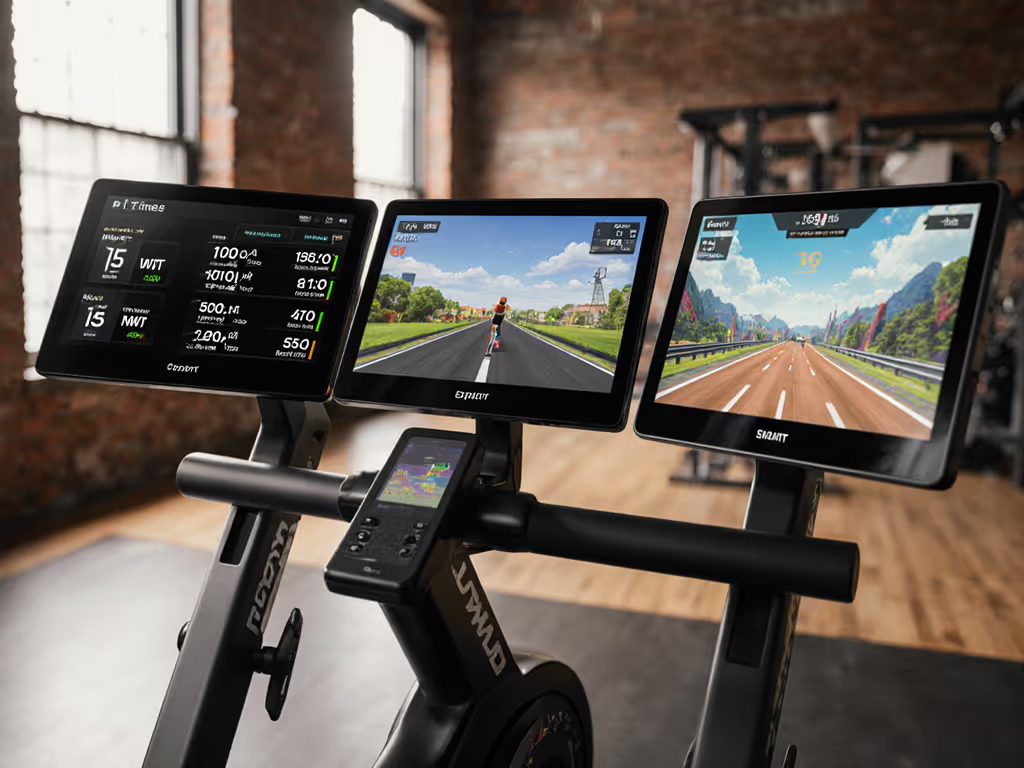
When a rowing machine monitor comparison matters, you're asking: What does the device truly measure, how reliably does it sync that data, and who controls your workout history? The answer shapes whether your progress feels portable or trapped.
The rowing ergometer standard is mechanical simplicity: a flywheel registers your stroke, sensors measure deceleration, and math converts that into metrics. But the leap from raw data to trustworthy numbers depends entirely on the monitor data accuracy path (which protocols the machine uses, how your apps talk to it, and whether a firmware update can retroactively rewrite your splits).
All modern rowing ergometers work from the same principle: measure flywheel deceleration between strokes. A sensor on the flywheel (typically magnetic or optical) registers each rotation. By timing the interval between pulses, the monitor calculates acceleration and deceleration, then estimates the power your stroke generated (measured in watts). Distance, pace (time per 500 meters), and stroke rate follow from that core number.
Concept2 Performance Monitors set the standard. The PM4 (and newer variants) samples flywheel speed frequently enough to produce a force curve (a second-by-second graph of power distribution across your stroke). This granularity is rare in consumer fitness. Most rowers smooth the data or skip the visualization entirely.
The ergometer display features on a Concept2 include time, distance, pace (time per 500m), watts, stroke rate, and force curve options. The monitor is programmable, you can display any metric in any combination, and it remembers your preferences between sessions. That consistency is subtle but important: your nervous system learns what a 300-watt effort feels like, and the number confirms it every time you sit down.
But counting watts accurately on your machine tells you nothing about whether that number is valid everywhere else.
This is where Priya Nair's framework enters. Any rowing monitor sits at a fork in the road:
Path 1: Open Protocols (FTMS, ANT+)
Concept2 PM5 models support Bluetooth FTMS (Fitness Machine Service, an open standard maintained by the Bluetooth SIG). For a deeper dive into open standards like FTMS and ANT+, see our FTMS & ANT+ connectivity comparison. When enabled, the PM5 broadcasts your stroke data as it happens. Any app implementing FTMS can receive it: Apple Health, Strava, Garmin Connect, or third-party rowing trackers. Your data is yours to move. You export your logbook, you port that history to new apps, you're never hostage to price increases or service discontinuation.
Path 2: Closed APIs
iFit-enabled rowers (common in home brands like NordicTrack, ProForm) use proprietary Bluetooth handshakes that only work with iFit's app. For accuracy nuances between PM5 and iFIT dashboards, read our PM5 vs iFIT monitor comparison. All metrics funnel through iFit's servers. You can't sync directly to Apple Health or Strava; you can export a CSV if you dig into account settings, but the workflow isn't designed for portability. Monthly subscriptions ($12-$45) unlock coaching and content. Your data lives in iFit's walled garden until (or unless) you request an export.
Ergatta occupies a middle ground: it uses local Bluetooth to sync with its own app, and it recently added FTMS support (v3.0+), enabling direct sync to Apple Health and Strava. However, Ergatta's differentiation (live leaderboards, gamified intervals) remains within-app. The open protocol integration feels supplementary, not core to the business model.
Why does this fork matter? Because rowing performance metrics reliability isn't just about local precision (does this machine accurately measure my stroke?). It's also about validity: If I row a 1:55 split today, and my app is gone in two years, do I still have that split as proof? Can I import it into a new app? Is it portable to a coaching relationship outside the ecosystem?
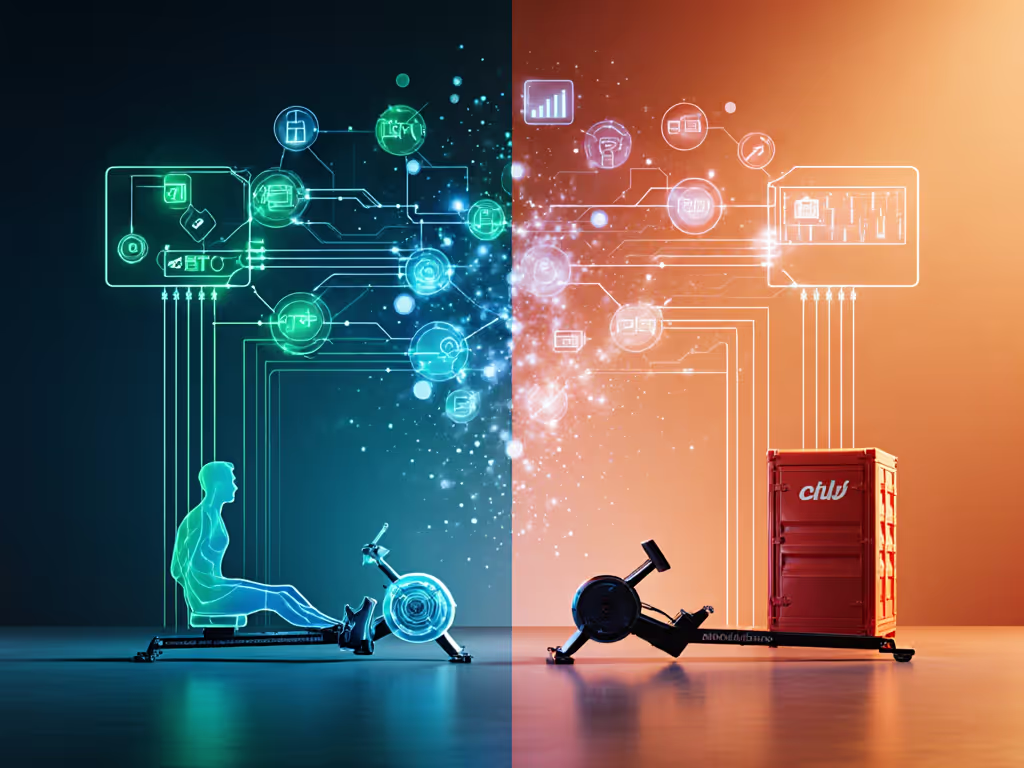
Here's the uncomfortable truth: All three systems measure the same thing using similar hardware. Their local accuracy is comparable, within 2-3% for power, and negligible for distance.
The accuracy divergence emerges in cloud-side post-processing. iFit's algorithm may apply smoothing to highlight trends. Ergatta's leaderboard logic may weight power relative to others' body weight. Strava's Fitness Signature model ingests your erg data but mixes it with outdoor rowing, cycling, and running metrics, so your rowing-specific profile can get diluted unless you filter activities. If Strava sync is a priority, check our Strava-compatible rowers guide for tested setups and caveats.